TMT interference unmixing
The problem
The reporter ions of a high-resolution MS2 scan come from everything the quadrupole isolated, not just the identified peptide. Precursor purity from MS1 misses much of this, because a lot of co-isolated ion current is below the MS1 detection limit. The result is ratio compression.
How it works
flowchart LR
    A["MS1 scans before and after<br/>the MS2 (same FAIMS voltage)"] --> B["Isolation-window record<br/>interpolated to the MS2 retention time"]
    B --> C["window ion current<br/>precursor's share on its isotope envelope<br/>estimate of ion current below detection"]
    C --> D["Per run: robust non-negative regression<br/>explains each scan's reporter sum"]
    D --> E["interference per scan<br/>(share not from the precursor)"]
    E --> F["unmix_ channels =<br/>intensity − interference × profile"]
No ground truth or reference channel is used; the coefficients come from the run itself. Original channel columns are unchanged, and the unmixed values are added alongside.
Measured on a knockout
Yeast triple-knockout TMTpro 16-plex (PXD017803). Interference is the median ratio of knockout to non-knockout channel intensity for PSMs of the three knocked-out proteins; the true value is zero.
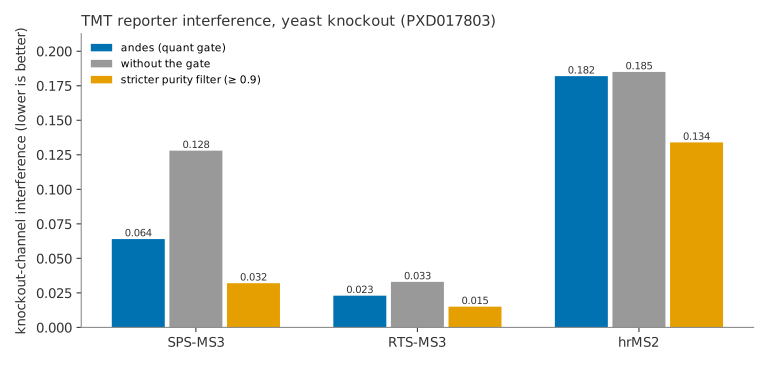
- andes's quantification gate (purity ≥ 0.7 and PEP ≤ 0.05) roughly halves the interference on SPS-MS3 (0.128 → 0.064).
- A stricter purity filter gives lower values but keeps fewer PSMs.
- On hrMS2,
--tmt-unmixsets the median knockout ratio to 0.000, at a background CV of 0.124 (0.080 without), so unmixing trades some precision for accuracy. - Only 36–91 knockout PSMs stand behind each value; read the bars as a direction.
Unmixing applies to high-resolution MS2 reporters only. SPS-MS3 reporters are not modelled.
andes --spectrum tmt.mzML --database proteins.fasta --tmt --tmt-unmix --rescore