Protein inference with picked target-decoy
andes infers proteins itself, with no external inference step, and gives each protein group a q-value from picked target-decoy competition.
flowchart TD
    A["Best rescored score<br/>per peptide"] --> B["Families with the same<br/>peptides form one group"]
    B --> C["A group whose peptides are a strict<br/>subset of another's is subsumed"]
    C --> D["Shared peptide counts for the group<br/>with the most peptides (razor)"]
    D --> E["Group score = best unique<br/>or razor peptide"]
    E --> F["Each target family competes with<br/>its own decoy: only the better one counts"]
    F --> G["protein_q = decoys / targets<br/>at or above the score, running minimum"]
A family is the unit of evidence: with a FASTA each entry is its own family; with an annotation database a family is a UniProt entry with its variants and isoforms, so alternative entries never split a protein's evidence. A target that loses to its own decoy gets q = 1.
Is the q-value honest?
Measured with entrapment databases: a group is false when every accession in it is an entrapment entry.
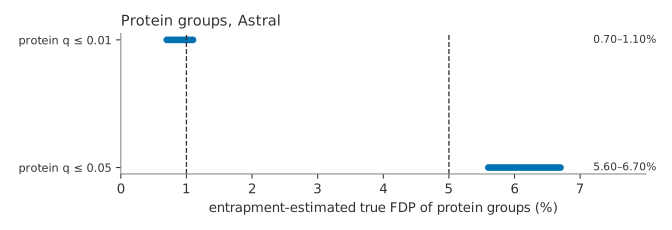
Astral, three peptide-level shuffled entrapments: 0.7–1.1% at protein q ≤ 0.01 and 5.6–6.7% at q ≤ 0.05 (dashed lines mark the nominal levels). UPS1 in yeast with an E. coli entrapment reads 5.0% at 1%, led by proteins that co-purify with recombinant proteins expressed in E. coli (EF-Tu, DnaK), so most of those are probably present and the shuffled design is the better measure.
andes inference runs the same inference once over the PSMs of several runs. Output goes into the
QPX bundle and the filtered TSV (protein_group, protein_q).