Retrieval and model choice
One model per file
andes reads the file's activation, resolution and isobaric label and picks one of 17 bundled scoring models, with no flag needed. An uncovered regime uses the nearest model.
flowchart LR
    F["Spectrum file<br/>mzML · .raw · .d"] --> M["Metadata<br/>activation · analyzer ·<br/>isobaric label"]
    M --> S{{"Model store<br/>17 models trained on<br/>public PRIDE data"}}
    S --> H["High-res HCD<br/>fused strong score"]
    S --> L["Low-res CID<br/>generating-function rank score"]
    S --> O["ETD · UVPD · TMT · iTRAQ ·<br/>phospho variants"]
All models are trained on public PRIDE data and the store holds no model data derived from other engines; the model table lists the training data of each.
Fragment-ion retrieval instead of scoring everything
The candidate index lives out-of-core, so candidates are retrieved by fragment ions that match the spectrum. High-resolution searches score only the best 100 candidates; on low-resolution data only the 150 most intense peaks vote.
flowchart LR
    A["FASTA<br/>digest + decoys"] --> B["Out-of-core<br/>fragment-ion index<br/>cached next to the output"]
    S["Spectrum"] --> R["Peaks vote for<br/>candidates"]
    B --> R
    R --> T["Top 100 candidates"] --> SC["Score:<br/>strong score + GBDT<br/>fragment-intensity features"]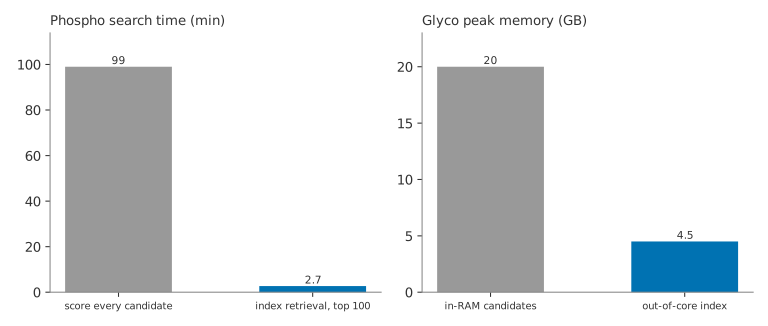
- Phospho (PXD007653): 164 s instead of 99 minutes.
- Astral: +22% PSMs at an equal true FDP with the retrieval design.
- Glyco: only candidates carrying an N-X-S/T sequon are held in memory (3.2 of 28.0 million), so the run peaks at 4.5 GB with output identical to the earlier in-RAM path (20.0 GB).
The cost of a full run against another engine is on the benchmarks page.