Chimeric cascade
The problem
A fragmentation spectrum is often a mixture: the isolation window lets in more than one peptide. A search that reports one peptide per spectrum leaves the second one unexplained, and its fragments become noise for the first.
How it works
flowchart TD
    A["Pass 1: normal search<br/>keep the top-N candidates per scan"] --> B["Primary peptide<br/>= best candidate"]
    B --> C["Find co-isolated precursors<br/>in the MS1 isolation window"]
    C --> D["Subtract the primary's<br/>fragment ions: residual spectrum"]
    D --> E["Pass 2: search the residual<br/>for a second peptide"]
    E --> F["PIN rows: one per peptide and<br/>modification multiset per precursor"]
Keeping the pass-1 alternatives rather than only the best candidate is what made the second pass pay off.
What it changes
Astral (PXD070049), at an entrapment-estimated true FDP of 1%, Percolator seeds 42, 1 and 2:
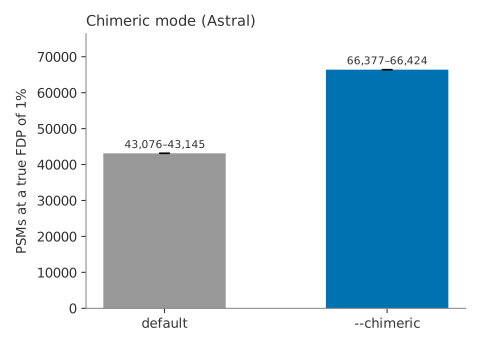
Distinct peptides rise by a smaller factor (29,384–29,400 against 26,723–26,746), so most of the
extra PSMs are second peptides of spectra whose first peptide was already known: the gain is
mainly depth, with some new coverage. The comparison is made at an equal true FDP of 1%,
because --chimeric rows carry a slightly higher true FDP at the same nominal q-value. On UPS1,
PSMs at q ≤ 0.01 rose 8.0% with entrapment hits flat. Measured on earlier builds
(2026-10-05 to 2026-10-13); the benchmark report has the
conditions.
Needs mzML or Thermo .raw; timsTOF .d falls back to a normal search.
andes --spectrum sample.raw --database proteins.fasta --chimeric --rescore --output-pin out.pin