Benchmarks
andes is measured on public PRIDE datasets for identification and quantification. Identifications
are counted after Percolator at q ≤ 0.01. Where the database carries an entrapment component,
we also report the true false discovery proportion (FDP), which says whether the nominal 1%
holds. Comparison engines are named with their version, and their numbers come from runs on the
same machine with the same rescoring, or from a public leaderboard.
This page is a visual summary. Dates, commits, database definitions and every row are in the full benchmark report; how to reproduce lists the commands.
Identifications
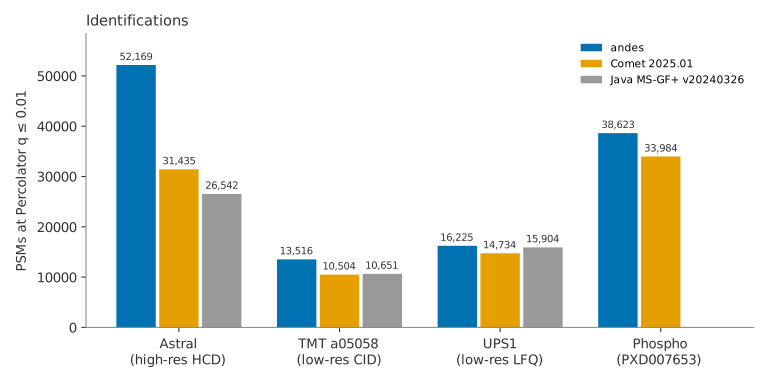
Java MS-GF+ was not re-run for this comparison: its counts are from an earlier session, so it is shown only where one exists. The phospho set is searched against mouse proteins with a whole-protein shuffled entrapment, the database both engines used.
Time, CPU and memory
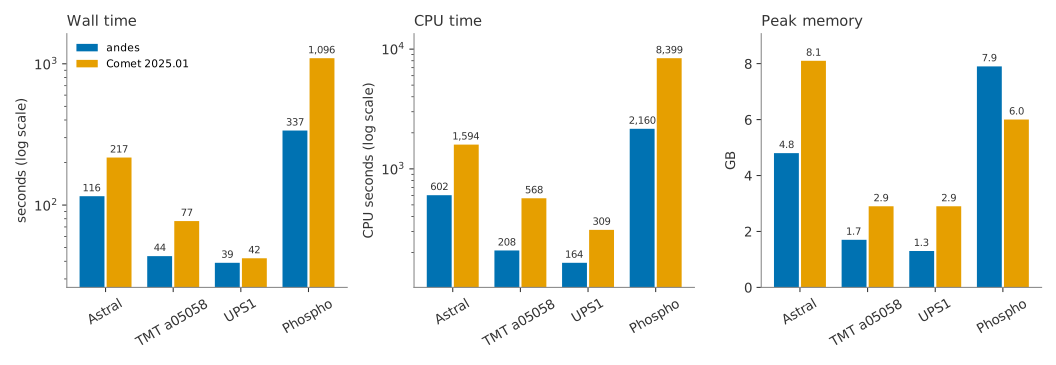
Wall times vary 5–15% between sessions; CPU time is steadier. Wall bars for andes are the midpoint of the reported range.
Error control: does the nominal 1% hold?
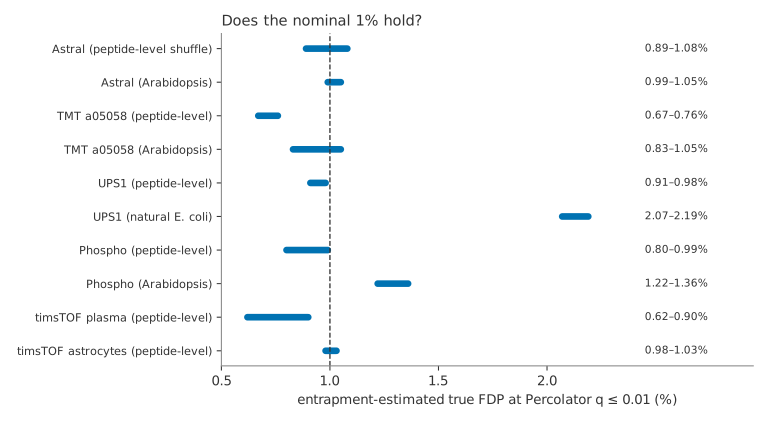
Each bar spans the entrapment-estimated true FDP over Percolator seeds and database realisations. The peptide-level shuffle is the primary design; the foreign (Arabidopsis) and natural (E. coli, yeast) entrapments are cross-checks. On UPS1 the two designs disagree, and the natural E. coli entrapment is the established reference there, which reads about 2.1%. Read the method notes before comparing across rows.
Optional modes
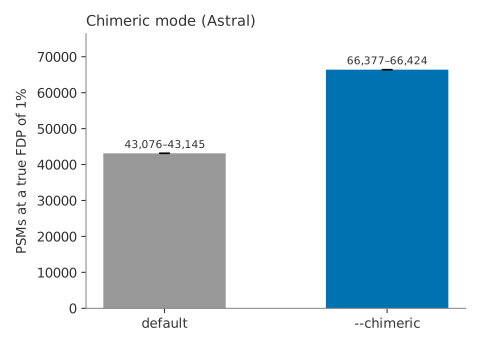
--chimeric reports second and later peptides per spectrum. Counts are at an entrapment true
FDP of 1% on Astral, measured on an earlier build.
Also benchmarked
- Glycoproteomics against five published tools on PXD065680: glyco benchmark.
- Quantification (label-free with match between runs against the ProteoBench leaderboard, TMT reporter-ion accuracy): quantification.
- timsTOF DDA-PASEF and the mouse-liver glyco set are in the full report.