Glycoproteomics benchmark: PXD065680
andes --glyco was run on the HCD F03 file of a published five-tool glycoproteomics comparison,
and its counts are placed beside that paper's per-tool counts. andes results carry an entrapment
error estimate; the paper's tools do not.
| Dataset | PXD065680 (jPOST JPST003908): BJAB-K20 membrane N-glycopeptides, Orbitrap Fusion, file F03 HCD |
| Paper | Sakaue et al., J Proteome Res 2026, doi 10.1021/acs.jproteome.6c00345: Byonic, Glyco-Decipher, MSFragger-Glyco, pGlyco3 and GRable |
| andes | main at 24cec490, Percolator 3.7.1, measured 2026-10-28 |
| Counted as | unique sequence + glycan composition, the closest rule to the paper's unit |
Counts
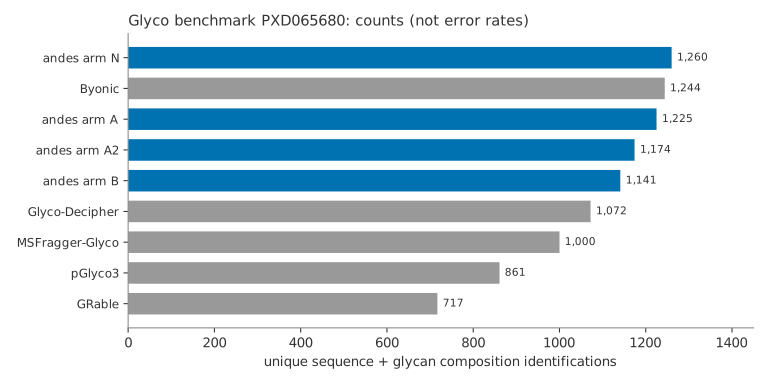
Counts, not error rates
The ranking compares counts. The paper gives no independent error estimate for its tools, and Glyco-Decipher and GRable apply no FDR filter. Every andes arm has an entrapment FDP at or above the 1% nominal (1.04–1.50%), so the andes bars are not a like-for-like error level with the 1% PSM FDR rule that Byonic, MSFragger-Glyco and pGlyco3 apply. The andes and paper protocols also differ (see Deviations).
The andes arms
| Arm | Unique | GlycoPSMs | Entrapment FDP | Settings |
|---|---|---|---|---|
| A | 1,225 | 1,679 | 1.14% | UniProt reviewed human (20,410), up to 3 missed cleavages, length 6–50, glyco tolerance 20 ppm |
| A2 | 1,174 | 1,616 | 1.18% (95% CI 0.43–2.57) | UniProt 2020_02 human (20,365), 2 missed cleavages, length 5–50, NeuAc list; closest to the paper's settings |
| N | 1,260 | 1,698 | 1.50% | as A2, NeuAc plus NeuGc list |
| B | 1,141 | 1,538 | 1.04% | as A, fragment tolerance 0.05 Da approximated as 100 ppm |
Percolator seed changes arm A between 1,225 and 1,234 identifications and between 1.14% and 1.89% FDP, so differences of a few dozen identifications against Byonic are inside that spread.
Overlap with the published tools (arm A2)
Computed against the Table S1 copy in the jPOST deposit (union 1,761 glycopeptides), which may be a preprint-era version; the final per-tool lists are larger, so these shares are lower bounds.
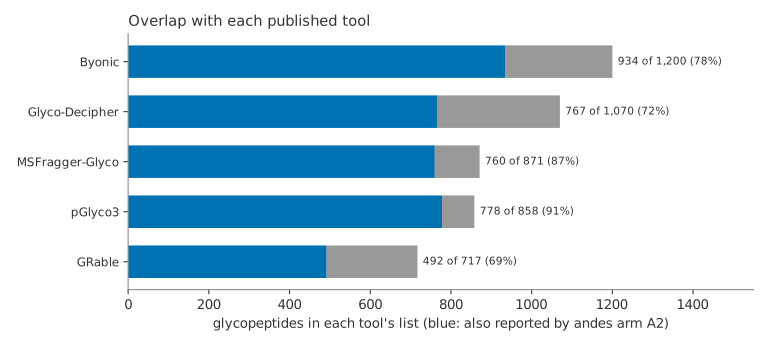
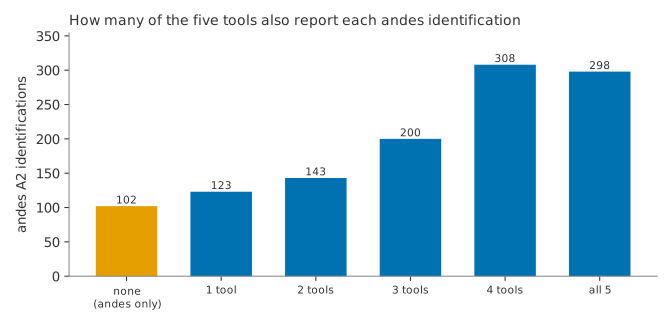
1,072 of andes A2's 1,174 identifications are in the union of the five tools. The remaining 102 are reported by none of them; at the other end, 298 are reported by all five.
Evidence tiers
The paper stratifies each PSM by glycan evidence (at least 4 of 5 HexNAc oxonium ions) and peptide evidence (Y0/Y1 and b/y ions) at 0.05 Da on the unfiltered spectra:
flowchart TD
    P["PSM"] --> O{"≥ 4 of 5 oxonium ions?"}
    O -- "no" --> T4["Tier 4"]
    O -- "yes" --> B{"b/y ions?"}
    B -- "yes" --> Y{"Y0/Y1 ions?"}
    B -- "no" --> T3["Tier 3: oxonium + Y0/Y1 only"]
    Y -- "yes" --> T1["Tier 1: all three"]
    Y -- "no" --> T2["Tier 2: oxonium + b/y only"]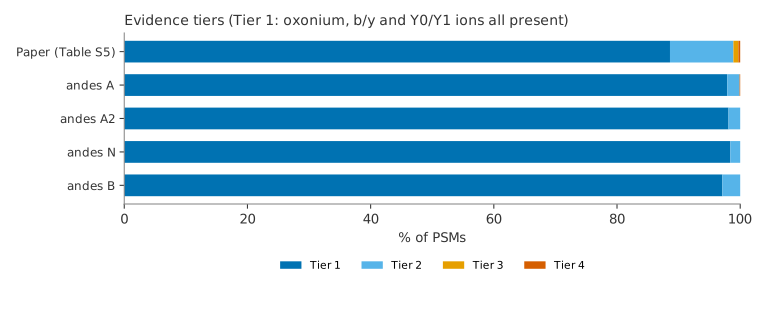
andes gates candidates on oxonium evidence during the search, and 0.05 Da b/y matching is permissive, so near-saturation in Tier 1 is expected. The tiers measure spectral support, not correctness; the entrapment FDP is the correctness estimate.
Rare sialic acids (NeuGc)
The paper's rare-sialic-acid search used a library with each NeuAc replaced by NeuGc or KDN.
| Source | NeuGc glycopeptides | Notes |
|---|---|---|
| andes arm N | 68 unique sequence + composition (77 glycoPSMs, 43 unique sequences) | 0 entrapment hits |
| Paper, Fig. 9A | Byonic 39, GRable 18, MSFragger-Glyco 8, pGlyco3 6 | counted as peptides; Glyco-Decipher found none |
22 of andes's 68 NeuGc identifications are in the paper's Table S2 (Byonic 21, GRable 8, pGlyco3 5, MSFragger-Glyco 3). NeuGc glycan trees were made by relabelling NeuAc leaves of the bundled human trees, so antenna placement is arbitrary. The KDN arm was not run: the andes glycan format has no KDN symbol, mass or diagnostic ions.
Deviations from the paper's protocol
- FASTA: UniProt release 2020_02 human (20,365 entries) stands in for SwissProt_Human_20200519, which was not obtained. Arms A and B used a different reviewed file (20,410 entries); the two share 20,301 accessions. Yeast Swiss-Prot entries are appended as entrapment targets.
- Missed cleavages and length: arms A and B used up to 3 and 6–50; arms A2 and N used 2 and 5–50, as in the paper.
- Peptide mass: the paper uses 350–10,000 Da; andes has no flag for it, so no limit was applied.
- Enzyme: trypsin only; the paper used LysC plus trypsin.
- Error control: Percolator at 1% for andes, against each paper tool's own rule.
- Glycan trees: the composition set matches the paper's, but andes needs trees, so bundled isomer trees were used (1,017 topologies for NeuAc, 1,862 for NeuAc plus NeuGc).
- Other settings: single file (no pooling before Percolator), precursor tolerance 7 ppm, fixed carbamidomethyl (C), variable oxidation (M), pyroGlu (N-terminal Q) and ammonia loss (N-terminal C).
- Counting rule: no rule tested on the deposit's Table S1 reproduces the paper's counts; sequence + composition is the closest (1,200 / 1,070 / 871 / 858 / 717 against the paper's 1,244 / 1,072 / 1,000 / 861 / 717). The final Table S1–S5 spreadsheets are needed to settle it.
- Training data: PXD065680 does not appear in any recorded andes training source; the source ledger was not audited exhaustively.
More glyco results (PXD005553 mouse liver, against pGlyco2 and MSFragger-Glyco) are in the full benchmark report. How to run it: intact N-glycopeptide search.